Tuesday, February 8, 2011

Russia and US get STARTed

The new Strategic Arms Reduction Treaty between Russia and the US has fully come into force after Russia’s Foreign Minister and the US Secretary of State exchanged ratified and signed documents.

Youtube clip

Following the ceremony, Russian Foreign Minister Sergey Lavrov announced that the New START treaty has taken effect in the form it was signed by the presidents of the two countries.

Even though the two sides had made so-called "special statements" or recommendations, they will not affect the actual implementation of the deal. The original text remains untouched.

"Russia and the US eventually manifested their responsibility for security in the world and their readiness to continue moving towards stability," Sergey Lavrov said. “We have many plans and we will try to implement all of them."

“I would like to underline that the START treaty [is in] the national interests of both the Russian and American people,”he added. “It favors nuclear non-proliferation and disarmament.”

Hillary Clinton said that in the course of 45 days, Russia and the United States are due to exchange complete information about their nuclear arsenals. She added that within 60 days the sides are due to resume mutual inspections.

Clinton observed that the countries have managed to attain visible progress in the “reset” process.

“Two years ago we all laughed about the translation of the ceremonial ‘reset’ button that I gave to the foreign minister in Geneva, but when it came to the translation that mattered most, our two countries, led by our two presidents, turned words into action to reach a milestone in our strategic partnership,” she said.

Sergey Lavrov and Hillary Clinton met on the sidelines of the international 47th Munich Security Conference which they were both attending. The documents they exchanged were earlier ratified by the parliaments of both countries after heated debate.

The US Senate backed the treaty in December 2010. Before ratification, American legislators amended the treaty, securing Washington’s right to modernize its remaining nuclear arsenal. Another statement stipulated that the treaty should not obstruct US defense plans in Europe.

Before giving their approval to the START treaty, the Russian State Duma also made several amendments to the document. One of them suggests that Moscow can back out of the treaty if it feels that US missile defense plans in Europe pose a threat to Russia’s national security.

The new treaty will obligate the two countries to cut their atomic arsenals by a third and will regulate military-nuclear relations between Russia and the US for the next ten years, with a possible five year extension option.

It was originally signed by presidents Dmitry Medvedev and Barack Obama on April 8, 2010 in Prague.

Nuclear disarmament campaigner Kate Hudson said that the New START treaty is a very important factor in the global trend away from nuclear weapons.

“The fact that the two biggest nuclear powers are engaged in a disarmament process must surely encourage other countries not to go down that route themselves, not to go down the nuclear proliferation routes,” she said.

“I think as an indication of the way the international community is moving on nuclear weapons, this is very significant indeed and of course, the way is open for the United States and Russia to pursue further bilateral reductions,” Hudson added. For the clip click here

Kommersant newspaper political analyst Sergey Strokan believes that the New START is sending a powerful message to the world community.

“When we discuss the importance of the START treaty, we have to understand that it is not only the deepest cuts of nuclear weapons in world history,” he said. ”The treaty is definitely an important political and psychological message, a message to the world powers that nuclear weapons are obsolete, they do not fit into the defense strategies of the world powers. They have to cut them.”

Strokan added that getting rid of nuclear weapons will make the US and Russia stronger.

“Definitely, it will make them stronger because it envisages not only cuts of nuclear weapons but also both sides would have to undergo modernizing of their potential,” he said. “That is why their military force will be more up-to-date.” For the clip click here

Professor of politics at the University of Kent, Adrian Pabst, told RT that the new treaty is a practical step toward genuine “reset” between Russia and the United States.

“It is a confidence-building measure. The ‘reset’ has often been dismissed as just nice rhetoric with little action, but now we have a concrete outcome of the reset in US-Russia relations and I think that both sides want to build on this,”he said. For the clip click here

Yury Rogulev from the Franklin Roosevelt Foundation of US Studies said that hopes are high that other countries will follow the example of the United States and Russia.

“The importance of this agreement is the example to the other countries,” he said. “First of all, to those countries that do have nuclear armaments and to those countries who do not agree to join the non-proliferation movement. This agreement between the United States and Russia, I think, would promote the non-proliferation process and would help to include other countries to the process of arms reduction.” For the clip click here

@RT

Saturday, February 5, 2011

Embracing Your Personal 'Sputnik Moments'

Sputnik Moments come like surprises that stir things up and force us to reevaluate how we see ourselves and our version of the world. They can have momentary or lasting impact, but they tend to unbutton our buttoned-down version of reality.

By Dr. Judith Rich, Speaker, trainer, writer, coach, creator of Rx For The Soul: www.judithrich.com

Had a personal "Sputnik Moment" lately? I'm not talking about the kind that President Obama referred to last week in his State of the Union speech, but let's use that analogy for a moment as a place from which to launch a more personal inquiry.

President Obama's reference to our current national "Sputnik Moment" was made in recognition of China's rise as an economic power and the challenge that poses to America's economic dominance in the world. Calling it a "Sputnik Moment" was a call for America to mobilize its resources and re-direct our national goals as we did in 1957 after the U.S.S.R. beat us in the race to space.

That original "Sputnik Moment" was America's wake up call. The government's response was to unleash a national effort to regain our competitive edge with the Soviets that resulted in stepped up missile development and the establishment of NASA. In addition, the U.S. government altered the ways in which it funded research in science, technology and engineering. This ultimately led to the development of the field of microelectronics -- the technology used in today's computers, tablets and smartphones.

Sputnik Moments are not confined to countries, however. They happen in our personal lives as well and by definition, come when we least expect them. Personal Sputnik Moments are those large or small events that jar our sense of reality, perhaps ever so slightly, or land like a major earthquake. One thing is for sure: after you've had one, nothing is ever quite the same.

Sputnik Moments come like surprises that stir things up and force us to reevaluate how we see ourselves and our version of the world. They can have momentary or lasting impact, but they tend to unbutton our buttoned-down version of reality.

Say you just found out you were adopted -- a Sputnik Moment. Or your birth mother contacts you and wants to meet -- a Sputnik Moment. Or the Dad you never knew and thought was long gone turns up unannounced -- a Sputnik Moment. Or you find out your spouse is having an affair -- a Sputnik Moment. Or your son or daughter comes home one day and announces that they're gay -- a Sputnik Moment. Or you just received a diagnosis of a potential life-threatening disease -- a Sputnik Moment.

But these kinds of moments are not always harbingers of bad news. Sputnik Moments can come on the heels of good news too. Say you just won the lottery -- a Sputnik Moment. Or you just got accepted to the college at the top of your list -- a Sputnik Moment. Better yet, say you received a scholarship to that college -- Sputnik Moment. Or you made the debate team, or the varsity squad in your sport. Or the person you'd been wishing and hoping would ask you for a date finally calls and asks you out. Or the person you've fallen in love with tells you he loves you. Or after two years of being unemployed, you finally land a decent job. These are all potential Sputnik Moments, after which nothing is ever the same.

Things can begin to unravel after a Sputnik Moment, but that isn't necessarily a bad thing. Sometimes the unraveling produces results you'd long been wanting but just didn't have the courage to go after without this nudge from the universe. Perhaps your child's admission about their sexual orientation finally opened up a new level of honest and authentic communication that wasn't available when he or she was still concealing that information.

Even an admission of infidelity can be the beginning of a new relationship built on a new level of honesty and restored trust. When the wall of denial finally comes crumbling down, and after the emotional content has been expressed, a new realm of possibility becomes available. How will you deal with what you now know?

What's important about a Sputnik Moment is what you do with it in the aftermath. The problem is, we tend to get all caught up in the drama of the story itself and might spend years or decades ruminating over the details, unable to move beyond our interpretation of what happened. We never get to resolution, but instead stay frozen in time.

A Sputnik Moment is like a sudden meltdown. It can occur when you finally realize there are more ways to view life's events than the one interpretation you latched on to and obsessed over for 10 years. A Sputnik Moment can be the realization of the role you played in the unfolding of events. We're often so blinded by our interpretations, we can't accurately see ourselves in the story.

A Sputnik Moment can serve to remove one's blinders, pierce the veil of denial, and place the observer right in the middle of the action instead of at its effect or on the periphery. Separating the facts from the story we craft about them can help one expand their options for how to respond instead of react. What if no one was guilty? What if no one is to blame?

From this vantage point, suppose you accepted that everyone did the best they knew how to do even if they came up miserably short in the process. Suppose you granted grace to all involved, including yourself. Suppose you blessed them, forgave them, forgave yourself, and let go of the frozen emotions you've stored away in a closed up heart. Suppose you saw yourself, over there in them, confused or lacking the courage to do the right thing or be honest in the moment.

Sputnik Moments can open our eyes to a deeper reality about who we are and what's really going on. The truth is, there's nobody else out there. Perhaps our ultimate Sputnik Moment is the realization that we're all in this together, that nobody's going to get out of this alive so we might as well claim our brotherhood and sisterhood and get busy rowing the boat of human kindness, love and compassion. Anybody got a better idea?

What's going on in your private nation in the "Sputnik Moment" department? How have your eyes been opened? What wake up calls have been delivered?

Please leave your thoughts on your personal and/or our collective Sputnik Moments in the comment section below or on my personal blog and website at Rx For The Soul. For personal contact you can reach me at judith@judithrich.com. I love to hear from you!

And why not Become A Fan? I'll fan you back... Click the Become A Fan button and be notified when new posts appear on Wednesdays. And most of all, love yourself and know that you are loved.

Blessings on the path...

@Huffington Post


Jhalanath Khanal elected PM of Nepal

Plagued by a "sleepless night" and fears that "lawmakers would not be able to venture out on the streets due to people throwing shoes at them", Nepal's Maoist chief Pushpa Kamal Dahal Prachandadecided to make a "sacrifice" and bow out of the 17th round of prime ministerial election Thursday.

However, it was more a defeat for India than the two losing politicians. Indian foreign secretary Nirupama Rao's recent visit to Nepal had not envisioned the possibility of such an opportunistic poll alliance between the Maoists and the communists and as Prachanda indicated in his exit speech, it was an act of defiance against "Indian interference".

KATHMANDU: Plagued by a "sleepless night" and fears that "lawmakers would not be able to venture out on the streets due to people throwing shoes at them", Nepal's Maoist chief Pushpa Kamal Dahal Prachanda decided to make a "sacrifice" and bow out of the 17th round of prime ministerial election Thursday. The surprise exit paved the way for the Maoists' last-minute poll ally, the ruling communists, to sail to a facile victory with their chairman Jhalanath Khanal pipping his remaining two contenders, Ram Chandra Poudel of the Nepali Congress, and this election's surprise contender, Bijay Kumar Gachhedar, who was backed by an alliance of regional parties from the Terai plains of southern Nepal.

The election, that started almost three hours behind schedule and continued for nearly five more hours, protracted by long speeches by the contestants, recriminations and counter-recriminations, saw the 61-year-old Khanal, a former information and communications minister, poll 368 votes, more than the simple majority needed. Poudel, who had fought 16 earlier rounds of fruitless elections for the last seven months, polled 122 votes while Gacchedar, the sitting deputy prime minister, got 67 votes.

However, it was more a defeat for India than the two losing politicians. Indian foreign secretary Nirupama Rao's recent visit to Nepal had not envisioned the possibility of such an opportunistic poll alliance between the Maoists and the communists and as Prachanda indicated in his exit speech, it was an act of defiance against "Indian interference". The Maoist supremo blamed India for the fall of his government in 2009, saying foreign forces had been trying to force him into agreements that would have compromised Nepal's sovereignty. "We want good relations with our neighbours but we won't brook interference," Prachanda warned. "My stepping down is meant to prove that we (Nepalis) can decide our own fate."

The election was delayed as the Maoists, facing the possibility of yet another round of fruitless election, decided to support the Communist Party of Nepal-Unified Marxist Leninist candidate minutes before the exercise started. In the past, the same party had derided a poll alliance between the communists and the Nepali Congress as "unnatural" and "unholy".

However, though Khanal's victory ends a seven-month vacuum, it will not be a bed of roses for him by any means. The snub to Gachhedar by the Maoists and communists has left the plains community – the Madhesis – as well as indigenous communities, especially his Tharu community, fuming. Lawmakers from these communities warned there would be "fire in the plains and hills" if the new constitution – to be promulgated by May 28 – failed to include their aspirations. They said they would refuse to obey such a constitution.

If the Nepali Congress, the second largest party in Nepal after the Maoists, also refuses to join Khanal's government, the remaining four months will see fresh turbulence in Nepal. Khanal will have to maintain a tough balancing act with his Maoist allies as well. He promised to integrate the Maoists' People's Liberation Army with the national army and rehabilitate those who wanted out within 90 days. It is a near-impossible promise as on one hand the Maoists will seek their pound of flesh for their support and try to get as many fighters in the army as possible and on the other hand the disgruntled opposition parties trying to block the move.

@Timesofindia

Friday, February 4, 2011

The Fight for Democracy: How Protests in Egypt & Iran Shatter Myths About Muslim Women

By Anushay Hossain, Editor/Founder, AnushaysPoint.com

Anyone remember what one of the most striking images to surface from Iran's uprising last summer over the falloutfrom the country's so-called elections were? Iranian women protesting.

The world was shocked to see Iranians, 70% of whom are under that age of 25-years-old, pour onto the streets demanding their votes be counted. But what was equally confusing for the world to see was thehuge role Iranian women played in shaping this revolt against their government.

Why should people be surprised? Iranian women, who make up 65% of university students in the country, are also amongst the most educated in the Middle East. They have been organizing underground for years under a regime that specifically targets their rights. In fact at the end of last summer's bloody protests, it was the face of a woman,Neda Agha-Soltan, brutally shot to death by an Iranian government sniper, who became the defining symbol for the "Green Revolution."

We are witnessing a very similar movement in Egypt. No, I am not talking about the fall of a "secular leader" (read: oppressive dictator backed by the US) in a Muslim country, thus leading to the creation of an Islamic State. I know this is the big fear of the West and the US media that the fall of Hosni Mobark's government, aka dictatorship, will only pave the way for Egypt to become the "new Iran."

I am talking about young people coming out in full-force to fight for democracy. I am talking about young Muslims fighting for their freedoms and quite literally being killed for it. We saw it in Iran last year and we are seeing it in Egypt today. Their fight for freedom breaks the age-old stereotype that Arabs and Muslims do not want democracy and are incapable of handling it. Unless of course it is hand-delivered by the US through invasion, occupation, and in some kind of three-step program ushered in by USAID, right?

These uprisings in a region where the majority of the population are young, educated, and craving the freedom to determine their destinies are shared by Muslim men and women alike. Just like we saw Iranian women come out to fight for their rights last year, we are seeing it in Egypt right now.

Women are at the forefront of these protests, breaking a huge stereotype about Muslim women: That we are passive, voiceless, and apathetic when it comes to our country's politics.

Democracy and women's rights go hand in hand. And no group understands that equation better than Muslim women. That is why they are always amongst the first to go out on the streets to fight for their future.

@Huffington Post


New Delhi wants extradition treaty

HIMALAYAN NEWS SERVICE

NEW DELHI; Indian Home Minister P Chidambaram and other high-ranking officials called on the visiting Nepali President in the Indian capital today.

Minister Chidambaram, who called on President Dr Ram Baran Yadav at the ITC Maurya hotel, informed about the President of India’s desire to sign an extradition treaty –– agreed at the bureaucratic level in 2005 –– along with a mutual legal assistance treaty with Nepal, according to Nepali Foreign Secretary Dr Madan Kumar Bhattarai.

“The minister spoke of the need of the treaty, but there was no pressure from him,” Dr Bhattarai said. He said the Indian government wanted Nepal to sign the treaty only when there was ‘enough comfort level’ on the issue.

Retired army general Ashok Mehta, who follows Indo-Nepal issues closely, told this daily the extradition treaty with Nepal has become crucial for India as Nepal has the potential of becoming a sanctuary for anti-India elements.

According to him, Indian law enforcement agencies apprehended 86 suspected terrorists, who had sneaked into India either from Bangladesh or Nepal in 2010.

Mehta said a crackdown on such ‘elements’ in Bangladesh meant Nepal could become a sanctuary for international terrorists, including LeT and Al Queda.

Mehta said experience from Bhutan –– used as a sanctuary by ULFA and Bodo separatists in the past –– showed such elements were equally lethal to the host country. Therefore, an extradition treaty would be beneficial for both the countries.

“There is already an insurgency problem in the Tarai. If the criminals and terrorists find safe haven in Nepal, they might even collude with local anti-social elements,” Mehta added.

Meanwhile, Bihar Chief Minister Nitish Kumar, who came to Delhi to meet President Yadav, said he discussed the need for a joint effort to control floods in Bihar and Nepal with the president. The President also held consultations on bilateral issues with Indian Finance Minister Pranab Mukherjee, Lok Sabha Speaker Meira Kumar, Defence Minister AK Antony and BJP leader Arjun Jaitley during the day.

कुशलले बनाए हावाबाट गुड्ने कार


महेशकुमार खाती: सोलारबाट गुड्ने कार बनाएर देशव्यापी चर्चा कमाएका बागलुङका युवा बैज्ञानिक कुशल के.सीले हावाबाट गुड्ने कार बनाएका छन् । जम्मा नौ दिनमा हावाबाट गुड्ने कारको नमुना बनाइ के.सीले परिक्षण गरेका हुन् । ‘हावा दिदा गुड्ने कार विश्वकै पहिलो हो’ बागलुङ बिनामारे ७ का १७ बर्षो कुशलले भने- ‘छोटो समयमा धेरै मेहनत गरेर परिक्षण सफल गराउन सकें’ ।

कारलाई यहि माघ २४ गते त्रिभुवन बिश्वबिद्यालयमा र्सार्वनिक गरीने छ । त्यसैगरी फागुन १ र २ गते हृवाइट हाउस कलेजमा आयोजना हुने हिमालयन साइन्स फेयर २०११ मा प्रदर्शन हुने बताइएको छ । सो कारको नाम ‘कुशल एयर कार’ राखेका कुशलले अघिल्लो बर्षनिर्माण गरेको सोलार कारको नाम भने कुशल सोलार कार राखेका छन् । इन्धनबाट भन्दा वातावरणिय लगायतका महत्वले पनि हावाबाट चल्ने कार भविष्यका लागि आवश्यक हुने उनले बताए ।

काठमाण्डौको नासा इन्टरनेसनल कलेज कक्षा ११ बिज्ञान संकायमा अध्ययनरत कुशलले जाडो बिदाको समयलाइ सदुपयोग गरी कारको नमुना बनाएर सफल परिक्षण गरेको बताए। काठ, बल्ब बेरिङ, प्लाष्टिक मिलाएर हावाको र्टवाइन दिएको सुनाए।

‘कार्बनडाइअक्साइड भएको सिलिन्डर प्रयोग गरेर हावा दिदां कार चल्यो ।’ कुशलले फोन वार्तामा भने- यसमा डाइनामो, इन्जिन र अन्य व्याट्री केहि पनि छैन, हावा दिंदा गुडिहाल्छ ।’ चाहेको गतिमा चलाउन हावा बढाए पग्ने उनले बताए । ‘दिनमा करिव १५ घण्टा भन्दा बढि समय लगाएर नौ दिनमा आमा बावाको अघि कार परिक्षण गराएको हु।’ कुशलले भने- ‘हावाले गुड्ने कार हुन्छ जस्तो लागेको थिएन, चारपटकको प्रयासपछि सफल भएं ।’ नमुना कार निर्माण गर्न कलेजले सहयोग गरेको उनले बताए । जम्मा १८ हजार खर्च लागेको उनले सुनाए । कलेजको सहयोमा करिव कार कार्टुन काठ, प्लाष्टिक र लुगा सुकाउने तारको चक्काबाट बनाइएको उनले सुनाए । अध्ययन गरेको कलेजको सहयोगमा बनाएको सो कारको नमुनालाइ कारको रुप दिएमा २ जनाले सजिलै यात्रा गर्न सकिने समेत बताए । ‘कुशल एयर कार’ नाम दिएको कारलाई सोलार कार भन्दा अझ सुन्दर र व्यवस्थित बनाउने बताएका छन् । ‘अव परिक्षा दिए पछि कारलाइ व्यवस्थित बनाउन लाग्ने छु ।’ उनले भने-कार्बनडाइअक्साइड भएको सिलिन्डर प्रयोग गरेर हावा दिदां कार चल्यो । ‘धेरै मेहनतका बावजुद हावाबाट उड्ने कार बावा आमाको अघि परिक्षण गर्दा अत्यन्तै खुसी लागेको छ ‘ उनले भने ।

गुरुत्वाकर्षा बलले र्टवाइन घुमाउने, बालुवाबाट टेस्ट गरेर र्टवाइन, गुच्चाबाट र्टवाइन घुमाउने प्रयास गर्दा पनि नभए पछि बल्ल कार्बनडाइअक्साइड भएको सिलिन्डर प्रयोग गरेर हावा दिएरु परिक्षण गर्दा सफल भएको बताए ।

दशै बिदामा आएको बेलोमा समेत कुशलले हवाइजहाजको नमुना तयार पारेको बताए । अब त्यसलाइ पनि परिक्षणको लागि तयारी गर्ने हो तर समय नपाएको गुनसो गरे । बढि लगानि र समय आवश्यक हुने भएकाले सोचे अनुरुप गर्न नपाएको उनले सुनाए ।

छोराको काम देखेर आमा बावु धेरै खुसी छन् । तर, सोहि अनुरुप वातावरण पुर्‍याउन नसकेकोमा दुखि भएको आमा रुद्रकुमारी के.सीले बताइन । सरकारले पनि आवश्यक सहयो र सल्लाह दिएको छैन उनले भनिन-गर्छु भनेर त भनेको छ सरकारले तर सोहि अनुसार भएको छैन् ।’

घरपरिवार र कलेजबाट राम्रो सहयोग पाएको छु, अब सरकारी पक्षले सहयोग र वाताबरण बनाइदिए चाडै सफल हुने थिए ।’ अघिल्लो बर्षअमृत आदर्श उच्च माबि कक्षा १० मै अध्ययन गर्दा सोलार जडानबाट कार गुडाएका कुशलले सरकारी पक्षबाट वास्ता नगरेकोमा गुनासो गरे । सरकारी पक्षबाट के कस्तो सल्लाह तथा सहयोग पाउनु भएको छ भन्ने प्रश्नमा उनले भने- ‘हे भगवान उसले त केहि वास्तै गरेको छैन् ।’ प्रधानमन्त्री माधवकुमार नेपाल लगायत उच्च सरकारी पदस्तलाइ समेत सोलार कार देखाउदा सहयोगको आश्वासन पाएका थिए ।

सोलार कार बनाए पछि करिव तीन दर्जन भन्दा बढि संस्थाबाट कुशल सम्मानित भएका थिए । सम्मान बापत पाएको रकम सोलार कार निर्माणमा खर्च भएको आमा रुद्रकुमारीले बताइन । सानो उमेर देखि बिज्ञानमा रुचि भएका कुशलले कक्षा ९ मा अध्ययनरत छंदा हेलिकप्टरको नमुना बनाइ परिक्षण गरेका थिए । सो समाचार पहिलो पटक धौलागिरी एफ.एममा प्रशारण र धौलागिरी जागरण दैनिकमा प्रकाशित भएका थिए ।

‘Mother’ to 35 children


Pushpa Basnet is only 28, yet she is ‘mother’ to a huge number of children – 35 young Nepali boys and girls to be precise.

Pushpa comes from a rich Nepalese family, and might have ended up going into business like her relatives if a visit to a prison in Kathmandu had not changed all that.

As part of her studies for a degree in Social Welfare, Pushpa met children who were living behind bars with mothers who had committed crimes like murder and drug trafficking.

Touched by the plight of one little girl, Pushpa decided to do everything in her power to get the children out of jail and look after them.

Now she has set up a charity and has effectively become the mother to 35 of the prisoners’ children.

Outlook reporter Rebecca Henschke went to meet Pushpa Basnet and her huge ‘family’ of children.

@BBC

To listen to the audio about the news please click here.

Kepler spots six planets orbiting a star

A Sun-like star with six orbiting planets has been discovered by the Kepler spacecraft in what NASA researchers are

Artist's rendition of the Kepler spacecraft

proclaiming as the biggest discovery in their field since the first exoplanet was discovered in 1995.

The six new planets have been located over 2000 light years from Earth orbiting a star roughly the same size as our Sun, which has been named Kepler-11. The planets were discovered by the transit method, which can detect a slight dimming in the light of a star as a planet sweeps across our line of vision from Earth. Prior to this finding, only one star was known to have more than one orbiting planet – Kepler-9, discovered last year, which has two confirmed planets and possibly a third.

We think this is the biggest thing in exoplanets since the discovery of 51 Pegasi-bJack Lissauer, NASA Ames Research Center

Five of the planets orbit closer to their star than any planet does to our Sun, with orbital periods between 10 and 47 Earth days, making this by far the most densely packed planetary system yet discovered. The orbit of the sixth planet, if placed within our own solar system, would reside between the orbits of Mercury and Venus.

“Because it was so unexpected and we’re getting so much information out of this system, we think this is the biggest thing in exoplanets since the discovery of 51 Pegasi-b, the first exoplanet back in 1995,” says Jack Lissauer of NASA Ames Research Center, California, who led the study.

Dimming starlight

By measuring the “depth” of each transit, which indicates how much starlight dims due to a transiting planet, the researchers were able to calculate the mass and radius of the each planet. In this way, they were also able to obtain the bulk density of each planet, which is already yielding clues to their compositions.

The six planets range in size from twice Earth’s radius to more than four times as large as Earth, and the researchers describe them as being relatively “puffy”, having fairly large radii for their masses. They suggest that the planets probably lie somewhere between the densities of Earth and Neptune, and the inner two planets may well be made from rock and water with a steam atmosphere.

However, they warn against making comparisons with Earth at this stage. “We’re still learning how nature makes planets in this intermediate mass range,” says Jonathan Fortney, one of the planetary composition specialists on the NASA team, based at the University of California, Santa Cruz. “It is clear that such planets need not resemble the Earth in any way, which adds to our incredible planetary diversity”.

Fortney adds that having so many planets in the same system will provide a unique opportunity to learn more about the geological evolution of individual planets, just as astronomers have compared planetary histories within our own solar system. The host star, Kepler-11, is older than the Sun, estimated to be 6–10 billion years old.

‘Absolutely stunning’ result

Suzanne Aigrain, an astronomer from Oxford University in the UK, who was not involved in the research, describes the new finding as an “absolutely stunning” result and agrees that many more details of individual planets will be revealed as Kepler continues to monitor the system. She also suggests that more specific details about planetary atmospheres could be discovered by looking at the spectrum produced by individual transits usng space, or possibly ground-based, observations.

The NASA researchers admit a degree of luck with this discovery because the transit method only works when the observer is located near the plane of an exoplanet. “Just because one planet in a system is observed to transit from a particular vantage point, doesn’t imply that all planets will transit viewed from the same perspective,” says Lissauer. He estimates that, for this reason, the Kepler-11 system could therefore be a one-in-10,000 solar system. “The Kepler-11 system is flatter than a CD. An old vinyl record would actually be a better analogy to the scale model of the planetary system we are seeing,” he says.

Lissauer believes that the surprising stability of the planetary system given the proximity of the planets to the star is due to damping effects shortly after the planets had formed. This, he speculates, could have been mediated by gas, or planetoids like between Mars and Jupiter in our own solar system. “But it had to have been lots of them in order to slow down eccentric motion and get them into a nice calm state that could last for billions of years.”

The researchers also speculate that a seventh planet could be residing between the orbits of the fifth and sixth planets, given the size of the gap and preliminary observations of the gravity effects between planets. This is a view shared by Carole Haswell of the Open University in the UK who is confident that other planets may well be found. “If there are such planets in the system, detailed analysis of the dynamics over a long timescale might allow them to be indirectly detected,” she says. “There could also be longer period transiting planets present which Kepler has not yet seen a transit of.”

The discovery is detailed in a paper in Nature.

About the author

James Dacey is a reporter for physicsworld.com

Wednesday, February 2, 2011

कुशलले बनाए हावाबाट गुड्ने कार

महेशकुमार खाती: सोलारबाट गुड्ने कार बनाएर देशव्यापी चर्चा कमाएका बागलुङका युवा बैज्ञानिक कुशल के.सीले हावाबाट गुड्ने कार बनाएका छन् । जम्मा नौ दिनमा हावाबाट गुड्ने कारको नमुना बनाइ के.सीले परिक्षण गरेका हुन् । 'हावा दिदा गुड्ने कार विश्वकै पहिलो हो' बागलुङ बिनामारे ७ का १७ बर्षो कुशलले भने- 'छोटो समयमा धेरै मेहनत गरेर परिक्षण सफल गराउन सकें' ।

कारलाई यहि माघ २४ गते त्रिभुवन बिश्वबिद्यालयमा र्सार्वनिक गरीने छ । त्यसैगरी फागुन १ र २ गते हृवाइट हाउस कलेजमा आयोजना हुने हिमालयन साइन्स फेयर २०११ मा प्रदर्शन हुने बताइएको छ । सो कारको नाम 'कुशल एयर कार' राखेका कुशलले अघिल्लो बर्षनिर्माण गरेको सोलार कारको नाम भने कुशल सोलार कार राखेका छन् । इन्धनबाट भन्दा वातावरणिय लगायतका महत्वले पनि हावाबाट चल्ने कार भविष्यका लागि आवश्यक हुने उनले बताए ।

काठमाण्डौको नासा इन्टरनेसनल कलेज कक्षा ११ बिज्ञान संकायमा अध्ययनरत कुशलले जाडो बिदाको समयलाइ सदुपयोग गरी कारको नमुना बनाएर सफल परिक्षण गरेको बताए। काठ, बल्ब बेरिङ, प्लाष्टिक मिलाएर हावाको र्टवाइन दिएको सुनाए।

'कार्बनडाइअक्साइड भएको सिलिन्डर प्रयोग गरेर हावा दिदां कार चल्यो ।' कुशलले फोन वार्तामा भने- यसमा डाइनामो, इन्जिन र अन्य व्याट्री केहि पनि छैन, हावा दिंदा गुडिहाल्छ ।' चाहेको गतिमा चलाउन हावा बढाए पग्ने उनले बताए । 'दिनमा करिव १५ घण्टा भन्दा बढि समय लगाएर नौ दिनमा आमा बावाको अघि कार परिक्षण गराएको हु।' कुशलले भने- 'हावाले गुड्ने कार हुन्छ जस्तो लागेको थिएन, चारपटकको प्रयासपछि सफल भएं ।' नमुना कार निर्माण गर्न कलेजले सहयोग गरेको उनले बताए । जम्मा १८ हजार खर्च लागेको उनले सुनाए । कलेजको सहयोमा करिव कार कार्टुन काठ, प्लाष्टिक र लुगा सुकाउने तारको चक्काबाट बनाइएको उनले सुनाए । अध्ययन गरेको कलेजको सहयोगमा बनाएको सो कारको नमुनालाइ कारको रुप दिएमा २ जनाले सजिलै यात्रा गर्न सकिने समेत बताए । 'कुशल एयर कार' नाम दिएको कारलाई सोलार कार भन्दा अझ सुन्दर र व्यवस्थित बनाउने बताएका छन् । 'अव परिक्षा दिए पछि कारलाइ व्यवस्थित बनाउन लाग्ने छु ।' उनले भने-कार्बनडाइअक्साइड भएको सिलिन्डर प्रयोग गरेर हावा दिदां कार चल्यो । 'धेरै मेहनतका बावजुद हावाबाट उड्ने कार बावा आमाको अघि परिक्षण गर्दा अत्यन्तै खुसी लागेको छ ' उनले भने ।

गुरुत्वाकर्षा बलले र्टवाइन घुमाउने, बालुवाबाट टेस्ट गरेर र्टवाइन, गुच्चाबाट र्टवाइन घुमाउने प्रयास गर्दा पनि नभए पछि बल्ल कार्बनडाइअक्साइड भएको सिलिन्डर प्रयोग गरेर हावा दिएरु परिक्षण गर्दा सफल भएको बताए ।

दशै बिदामा आएको बेलोमा समेत कुशलले हवाइजहाजको नमुना तयार पारेको बताए । अब त्यसलाइ पनि परिक्षणको लागि तयारी गर्ने हो तर समय नपाएको गुनसो गरे । बढि लगानि र समय आवश्यक हुने भएकाले सोचे अनुरुप गर्न नपाएको उनले सुनाए ।

छोराको काम देखेर आमा बावु धेरै खुसी छन् । तर, सोहि अनुरुप वातावरण पुर्‍याउन नसकेकोमा दुखि भएको आमा रुद्रकुमारी के.सीले बताइन । सरकारले पनि आवश्यक सहयो र सल्लाह दिएको छैन उनले भनिन-गर्छु भनेर त भनेको छ सरकारले तर सोहि अनुसार भएको छैन् ।'

घरपरिवार र कलेजबाट राम्रो सहयोग पाएको छु, अब सरकारी पक्षले सहयोग र वाताबरण बनाइदिए चाडै सफल हुने थिए ।' अघिल्लो बर्षअमृत आदर्श उच्च माबि कक्षा १० मै अध्ययन गर्दा सोलार जडानबाट कार गुडाएका कुशलले सरकारी पक्षबाट वास्ता नगरेकोमा गुनासो गरे । सरकारी पक्षबाट के कस्तो सल्लाह तथा सहयोग पाउनु भएको छ भन्ने प्रश्नमा उनले भने- 'हे भगवान उसले त केहि वास्तै गरेको छैन् ।' प्रधानमन्त्री माधवकुमार नेपाल लगायत उच्च सरकारी पदस्तलाइ समेत सोलार कार देखाउदा सहयोगको आश्वासन पाएका थिए ।

सोलार कार बनाए पछि करिव तीन दर्जन भन्दा बढि संस्थाबाट कुशल सम्मानित भएका थिए । सम्मान बापत पाएको रकम सोलार कार निर्माणमा खर्च भएको आमा रुद्रकुमारीले बताइन । सानो उमेर देखि बिज्ञानमा रुचि भएका कुशलले कक्षा ९ मा अध्ययनरत छंदा हेलिकप्टरको नमुना बनाइ परिक्षण गरेका थिए । सो समाचार पहिलो पटक धौलागिरी एफ.एममा प्रशारण र धौलागिरी जागरण दैनिकमा प्रकाशित भएका थिए ।

India in Afghanistan: Engagement without Strategy

India’s policy towards Afghanistan after 9/11 has rested on three prongs – greater economic engagement, support for the Karzai government, and thwarting the Taliban’s return to power in Kabul. The Indian objective is to prevent Afghanistan from emerging as a theatre for radical Islam and a launch pad for terrorism against India. However, India has failed to convert the third prong of its strategy into reality. The London conference, held last year, made the return of the Taliban – good and bad – a reality. After years of a spiteful relationship, Karzai has warmed up to Islamabad to seek its help to facilitate negotiations with the Taliban.

India’s strategy to prevent the Taliban from returning to the centre stage of Afghan affairs had relied on America’s ability to militarily enforce stability and on the Karzai government’s capacity to provide effective governance. However, India underestimated Pakistan’s capacity to play the role of a spoiler. With the Taliban return to power appearing inevitable, India has introduced an important nuance in its position. In the words of Foreign Minister S.M. Krishna “the process (of reintegration of the Taliban) should be Afghan-led, inclusive and transparent, and any external interference in the reintegration process would be detrimental both for its success and for the future of a democratic, stable, pluralistic and prosperous Afghanistan.” The truth of the matter is that Pakistan remains central to the success of the process of reconciliation and reintegration. In the words of Pakistan’s Prime Minister Yousuf Raza Gilani, “nothing will happen without us, because we are part of the solution.” American helplessness and frustration are evident from the increasing number of drone attacks to alter the strategic equations in Afghanistan. Writing in the New York Times, Bruce Riedel noted that there are serious limitations that America faces in Afghanistan and “we cannot make Pakistan stop being naughty.”

The economic crunch and increasing casualties have made a long term Western presence in Afghanistan untenable. The United States has linked its exit strategy to a relatively stable Afghanistan that does not pose a serious threat to its interests. At the same time, it refuses to recognise the organic link between the Taliban and al-Qaeda and continues to remain focussed “on disrupting, dismantling and defeating al-Qaeda in Afghanistan and Pakistan…”

Groups that can make a significant difference to the escalating violence in Afghanistan are the Haqqani group based in North Waziristan, the Quetta shura, and now the Karachi shura (as speculated in the media) – all controlled by Pakistan’s intelligence agency. There is very little influence that India has over these groups which are now poised to play a major role in Afghanistan. India realises that any workable strategy in Afghanistan would involve Pakistan. Like the US, it prefers those Taliban who abjure violence and accept the Afghan constitution. Under these circumstances, what India needs is a new strategy that protects its interests in Afghanistan.

The US has described its exit strategy as ‘aspirational goals’ which are not cast in stone since it realises that there are difficulties in operationalising the strategy that was put together at the Lisbon NATO summit in December and which was reiterated in Obama’s speech of December 16. India has argued that any troops pull out must be situation-based rather than calendar-based. Moreover, a 42 per cent increase in Afghan security forces by October 2012 to facilitate the exit strategy is not plausible give the shortage of 700 trainers.

India faces immense challenges in Afghanistan. It is engaged in developmental work in Pashtun dominated areas, yet it is seen as a friend of the erstwhile Northern Alliance and cannot count many friends among the Pashtun leaders. Karzai’s controversial election, corruption charges against his government, and his attempt to sideline detractors, have all made his government unpopular at home and invited scathing criticism from abroad. India’s support for Karzai only accentuates the Pashtun mistrust, though India is left with no choice but to support an elected government.

India’s economic engagement in Afghanistan has earned immense goodwill at the popular level. However, India lacks a political strategy to cater for the return of the Taliban. It is apprehensive about making further investments as it is not sure of the political configuration that may emerge in the future. It is plausible that the Taliban may not replicate their old regime, but there is a possibility of political instability that may offset India’s economic presence. However, given the geo-strategic flux, India needs to chart a policy that minimises its losses in Afghanistan.

India needs to take proactive steps to mobilise other countries of the region that have similar concerns regarding the reconciliation and reintegration of hardcore Taliban elements. There are several options that can be attempted in cooperation with countries of the region. One way would be to prevent the Pakistan-backed radical groups from assuming a dominant position in Afghanistan. The other option would be to reduce the Afghan government’s dependence on Pakistan for trade and transit, which would enable Kabul to be more independent and less subject to Pakistani arm twisting. India needs to take the lead in engaging countries that border Afghanistan. Pakistan should also be engaged to minimise mistrust and suspicion. India has already signed on to the TAPI pipeline project along with Pakistan and Afghanistan, and consultations must be directed at facilitating future energy cooperation. India needs to seriously pursue the development of Chabahar port. There are reports that Indian companies are bidding for Hagijak mines in Bamiyan province and they would need an outlet to get these minerals. To ensure stability in Afghanistan, the countries of the region need to ensure that Afghanistan’s ethnic minorities find adequate representation in a future government.

Other countries of the region are preparing for the post transition phase as is evident from the first visit of Russian President to Afghanistan. Iran for the first time attended the NATO dominated international contact group meeting in Rome in October 2010. Like India, Iran would have an interest in ensuring that the future government in Kabul does not become an extension of the security establishment in Rawalpindi and should be truly an Afghan initiative. There is a need to engage China and Tajikistan which are unlikely to be comfortable with the return of Taliban. Countries of the region have followed separate policies in Afghanistan and this has tilted the balance in favour of Pakistan. India should therefore step up its engagement of these countries. This is likely to bear more fruits than formal multilateral forums that tend to take a geographical criterion rather than a commonality of interests.

@IDSA


Tuesday, February 1, 2011

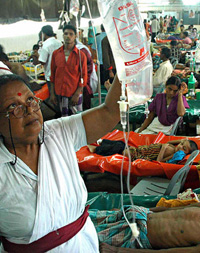
Medical tourism strains health systems

BANGKOK, 31 January 2011 (IRIN) - From hip replacements to hysterectomies, southeast Asian countries have seen a

Photo: Shamsuddin Ahmed/IRIN Many countries are already feeling the impact
rapid growth in medical tourism, with about two million international patients a year seeking bargains there.

But according to the World Health Organization (WHO), medical tourism is leading to some highly skilled specialists, as well as other trained medical staff, leaving public health facilities for private ones. Further down the medical hierarchy unemployed or undertrained staff end up filling chronic shortages in remote areas.

Churnrurtai Kanchanachitra, a professor at Thailand’s Mahidol University and co-author of a recent paper on health worker shortages and the international trade in health services, warned of the dangers:

“There are five countries [in Southeast Asia] facing a shortage of health professionals, mostly in rural areas,” said Kanchanachitra. “This will only become a more pressing issue with the continued growth in trade in health services.”

Thailand reported US$1.4 billion in revenues from medical tourists in 2008 - about 30 percent from medical procedures and 50 percent from shopping. The national tourism authority has projected attracting 10 million medical tourists by 2015.

Over the past decade the Association of Southeast Asian Nations (ASEAN) has gradually liberalized trade in services, with health as one of the 11 priority areas. In 2001 member countries started negotiating mutual recognition arrangements to facilitate the migration of professionals, with the expectation that health workers could migrate easily by 2010.

The US-based trade group Medical Tourism Association estimates the value of global medical tourism will increase to $100 billion in 2012.

In total , Indonesia, Vietnam, Laos, Cambodia and Myanmar are short of nearly 250,000 health professionals to meet WHO minimum standards of care (covering 80 percent of births and measles immunizations), based on country data.

Brain drain?

In 2004 Indonesia was one of the top three places in Southeast Asia where health workers undertook training prior to seeking work in Organisation for Economic Co-operation and Development (OECD) countries, according to OECD.

Arina Nurfianti, a 26-year-old nurse teaching in Indonesia’s West Kalimantan Province (on the island of Borneo), said she wants to go abroad for more money and better work conditions if she can get the paperwork.

"I still do not have an international registered nurse certificate to allow me to work overseas. Many Indonesian nurses who work overseas do not have such a certificate, which is why many of them are working as assistants to nurses."

Nigel Crisp, a UK parliamentarian and doctor who has worked on issues of health worker training and global partnerships, concluded: “The trend is towards an increase in health worker migration, and the chance is weak that poor countries can benefit.” Knowledge gained working overseas, strengthened accreditation and remittances help, but may still leave poor countries benefiting less from migration, he said.


Photo: Brennon Jones/IRIN
Training remains a challenge
Health worker migration forms a small part of the trade in health services, with e-health (e.g. medical transcription - the conversion of voice-recorded reports, as dictated by physicians and/or other healthcare professionals, into text format), medical tourism and health infrastructure investments forming the bulk of current trade, according to experts at a recent WHO meeting on the impact of trade in health services on human resources in health.

Training paramount

Current problems with health worker shortages worldwide cannot be blamed on migration alone.

“Migration is an issue, but it is not the biggest issue. In Africa some 135,000 health workers have emigrated [in recent decades] and there is a shortage of some 1.5 million health professionals. The biggest issue is how to improve training to fill that gap,” said Crisp.

He called on developed countries to form bilateral agreements with the countries from where they accept health worker migrants, and to invest in exporting countries' health systems and health worker training, and not set up alternative training institutions which could compete with, and wipe out, local ones.

UN member states adopted an international code of practice in May 2010 to promote the ethical recruitment of health personnel, protect migrating workers’ rights and minimize the negative effects of such migration, but it is voluntary, non-binding and difficult to enforce, said John Hancock, a World Trade Organization adviser.

“The global architecture [of trade in health services] promotes efficiency. That is the nature of capitalism. What is still missing in that architecture is how to work equity into the equation,” said Hancock.

HOW TO: Rescue people from a flood

JOHANNESBURG, 31 January 2011 (IRIN) - Imagine you and your family are camped out on the second floor of your

Photo: RNLI RNLI volunteers rescue survivors from the flooded town of Cockermouth in northwest England in November 2009
house watching floodwaters rising steadily towards your bedroom window. It is too late to evacuate; your only hope is for someone to come and rescue you.

But rescuing people from a flood is not as simple as dispatching a boat or a chopper. It takes high levels of training and coordination for rescue teams to bring survivors to safety without endangering themselves. Here is how they do it.

The training

There are two basic types of floods: those that occur gradually, such as the recent flooding in Australia, allowing communities time to move to higher ground; and flash floods that may happen with little or no warning, like those that caused significant loss of life in Brazil in mid-January. It is flash floods that usually present the greatest risks and challenges to rescuers.

Anyone involved in flood rescue should have training in first aid and how to operate a radio, but many are also certified in Swiftwater Rescue. Hugh Fogarty, who heads the flood rescue team of UK charity, the Royal National Lifeboat Institution (RNLI), explained that the first thing individuals learn during Swiftwater Rescue training is hydrology, or “how water behaves when it’s moving very quickly through a confined channel”. This includes learning how to read the surface of the water for clues about the location of hidden obstacles like cars and concrete posts that could capsize your boat.

Next, trainees learn how to keep themselves safe through skills such as “defensive swimming” and precautions like using a pole to check for open manholes when wading through floodwater. Working as a team can also decrease risk: one member of a team may be deployed upstream to warn teammates of large debris being swept towards them while two more may be stationed downstream with ropes in case someone falls into the water.

Rescuers also need to know how to handle a boat in fast-moving water. According to Julie Ryan, a volunteer with British NGO the International Rescue Corps (IRC), there are ways to angle a boat so it is not fighting the current.

The kit

Preparedness kits issued to Red Cross volunteers doing flood rescue in Mozambique include whistles and a megaphone to communicate with survivors, ropes for pulling them to safety and extra life jackets and rain gear to keep them safe and dry. The kits also contain lanterns and flares, and radios for staying in touch with HQ.

Assessing the situation

Before dispatching rescue teams, you need to know where to send them. Large expanses of floodwaters can mask landmarks leaving unprepared rescuers disoriented and unable to locate survivors. Air reconnaissance can be helpful for building a picture of what is happening on the ground, but is not always available.

''We wouldn't just ride round and look for people. We'd know where we were going and what we were looking for''
Rescuers have training in how to read the contours of a map to work out which areas would be flooded, but also rely on local knowledge to guide a search. Organizations like the Red Cross and the IRC have networks of local volunteers who may know how many people are marooned in a particular farm, village or street. Where cell phone technology is available, survivors themselves may alert emergency services of their location.

“We wouldn’t just ride round and look for people,” said Ryan of the IRC. “We’d know where we were going and what we were looking for.”

Information about particular risks associated with a flood situation is also helpful. Ryan recalled that during a November 2009 mission to rescue people from the flooded town of Cockermouth in northwestern England, police informed them that the rapidly flowing water had emptied a scaffolding yard and they should watch out for the heavy metal poles.

The rescue

Getting survivors from dry land onto a boat is relatively simple, but rescuing them from the second floor of a building surrounded by rushing water presents more of a challenge. In such situations, a second boat may be sent slightly upstream to create an eddy that holds the first boat in place against the side of the building while people are loaded into it.

Read more
How To: Rescue people trapped in a collapsed building
How To: Track the scent of life
How To: Do a food airdrop
As most rescue boats can only accommodate three or four people at a time, rescuers prioritize the injured, the young and the elderly and often have to make several trips to bring everyone to safety.

If, despite all precautions, someone does fall into the water, a spotter on the boat would try to keep them in sight for as long as possible. "The worst scenario is they just disappear and you’re unable to locate them," said Ryan. "But you’d hope they’d manage to find somewhere to hold on until you catch up to them."

Once everyone is on dry land, rescue teams hand over to relief agencies to feed and shelter survivors and begin the long process of restoring areas covered in mud and debris.